

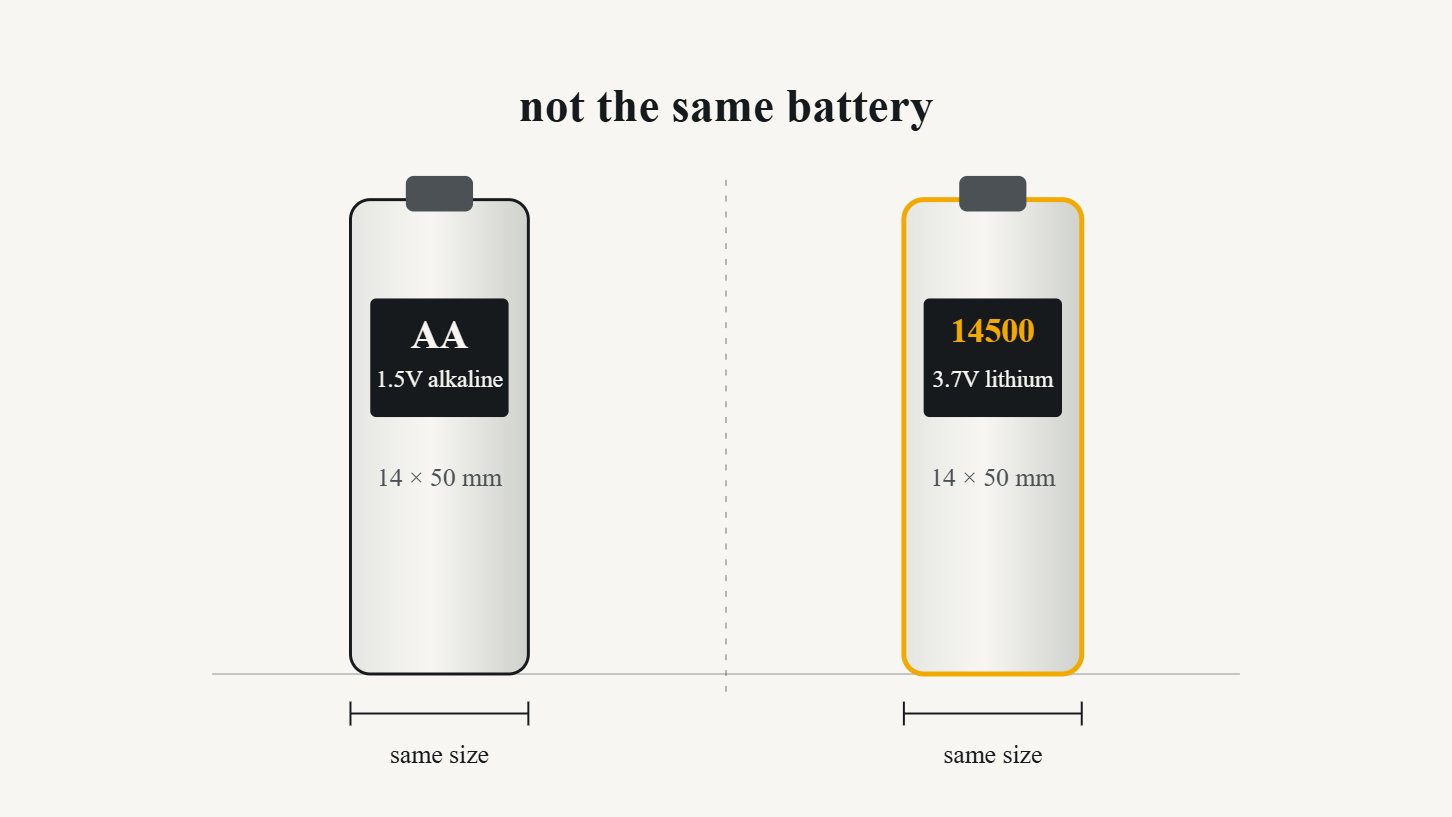
A bare 14500 battery is not an AA battery. It has amost the exacy same size and shape, but a typical 14500 lithium-ion cell has a nominal voltage of 3.6–3.7 V, compared with 1.5 V for an alkaline AA.
Don’t put one in a device unless the manufacturer’s documentation explicitly confirms compatibility.
Why is that the rule when the two fit the same compartment? Because physical fit doesn’t tell you whether the circuit inside can handle the battery’s voltage.
What the numbers on a battery tell you
Common battery names like AA and 14500 are size codes. “AA” describes a size. So does “14500”: the 14 is the width in millimeters and the 50 is the length. That works out to roughly 0.55 by 2 inches. The name says nothing about what is inside.
Inside is where the two part ways. Every 14500 of the 20 we found for sale is a lithium cell. A standard one runs at about 3.6 to 3.7 volts and charges up to 4.2 volts. Voltage is the electrical push a battery supplies, and it is the number that matters most here.
An “AA” is less simple than it sounds. The name covers two different kinds of battery inside the same shell. An alkaline AA is 1.5 volts. A rechargeable NiMH AA is 1.2 volts. On paper, then, the 14500 delivers about 2.4 to 2.5 times the voltage of an alkaline AA, and about three times that of a NiMH.
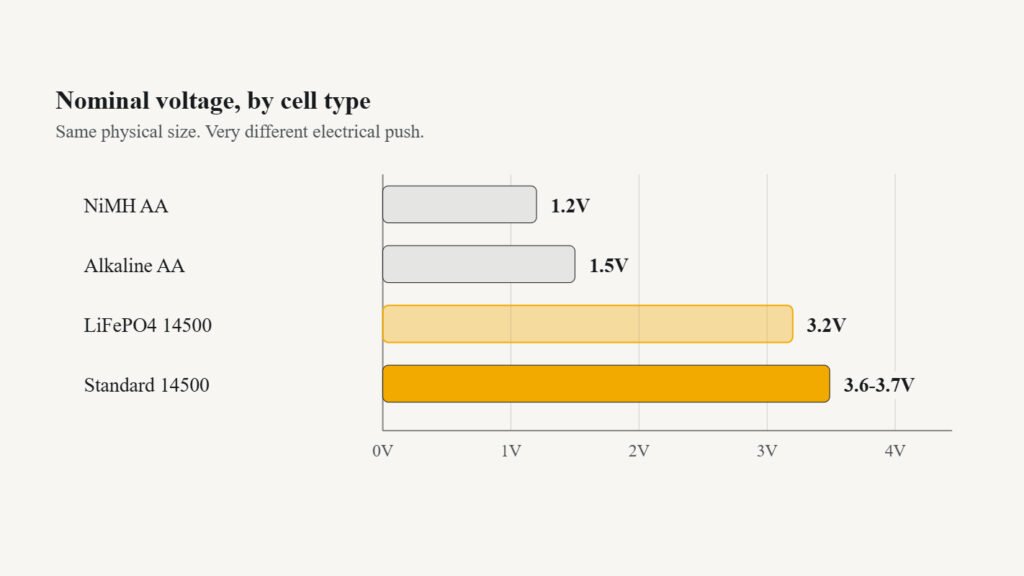
Cell | Nominal voltage | Rechargeable? | Size |
|---|---|---|---|
Alkaline AA | 1.5 V | No | ~14 × 50 mm |
NiMH AA | 1.2 V | Yes | ~14 × 50 mm |
Standard 14500 (lithium-ion) | 3.6–3.7 V (4.2 V fully charged) | Yes | ~14 × 50 mm |
LiFePO4 14500 | ~3.2 V | Yes | ~14 × 50 mm |
Voltages are the “nominal” (average working) figures printed on manufacturer datasheets from Panasonic, Vapcell and several AA makers. Datasheets round the lithium figure to either 3.6 or 3.7. The sizes overlap across those datasheets, within normal manufacturing tolerance.
The last row is a small exception. Some 14500-sized cells use a different lithium recipe called LiFePO4, at about 3.2 volts. That is still well above an AA, and lower than the standard 14500, not higher. We found real examples for sale but have no data on how common they are.
So a 14500 is not a rechargeable AA. It is a different kind of battery in an AA-shaped body.
What goes wrong
Nothing about the shape warns you. A 14500 usually slides into an AA compartment without complaint. The trouble shows up in the light’s electronics, which decide what to do with the extra voltage.
A flashlight has a small circuit, often called a driver, that controls how much power reaches the LED. Some drivers limit the current. Some barely limit it at all. You can’t tell which by looking. That one fact explains why the outcomes vary.
Forum reports show the spread, though only as individual stories. One user described a light with overvoltage protection that simply refused to turn on when a 14500 went in. Another described a two-cell light that kept working at first on 14500s, then developed a switch that only worked momentarily.
These are single reports, not tests, and they say nothing about how often each outcome happens. What they show is that the range runs from nothing to real damage.
One documented mechanism explains the worst case. An LED’s current does not rise in step with voltage. It rises far faster. In one LED maker’s technical guide, a typical white LED draws around 100 milliamps at 2.9 volts and more than 700 at 3.3 volts.
Engineering material from Texas Instruments describe why this gets worse. More current makes the LED hotter. A hotter LED needs less voltage to pass the same current, so still more current flows. The loop is called thermal runaway, and it can destroy an LED in seconds.
But that story applies to an LED with no effective current control. We did not find reliable evidence of how a typical AA-designed driver reacts to a higher input. Some may shut down. Some may pass the extra voltage straight through. Some may fail in ways we haven’t described.
That uncertainty is the point. If nothing bad happened once, that tells you little about the next light.
More cells, more voltage
Everything above assumes one battery. Many devices take two or three.
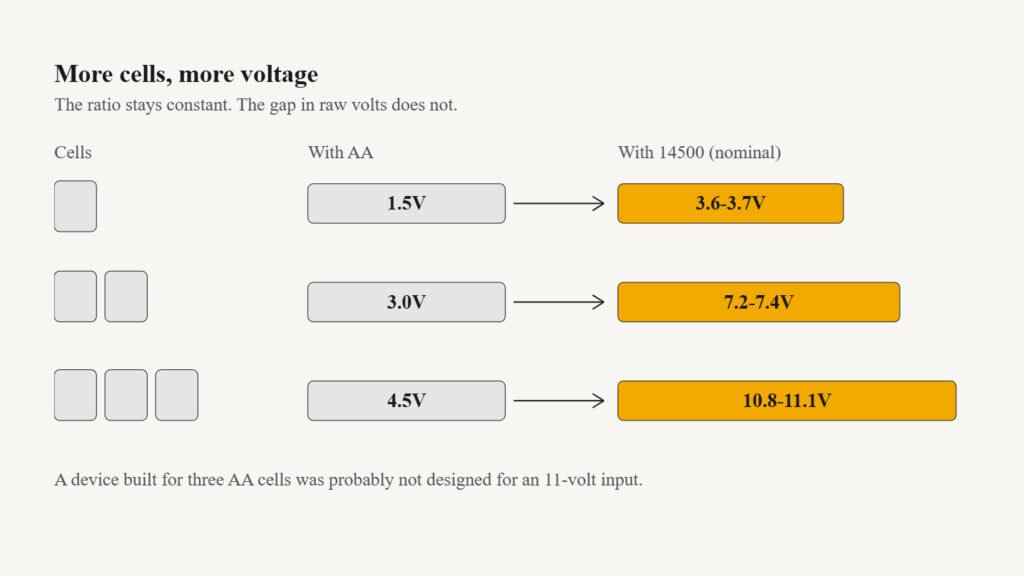
Batteries lined up end to end, in what’s called a series circuit, add their voltages. Two alkaline AAs make 3 volts. Two 14500s make about 7.4 volts, and 8.4 volts fresh off a charger. Three cells take you from 4.5 volts to about 11.
Cells in device | With alkaline AAs | With 14500s (nominal) | With 14500s (freshly charged) |
|---|---|---|---|
1 | 1.5 V | 3.6–3.7 V | 4.2 V |
2 | 3.0 V | 7.2–7.4 V | 8.4 V |
3 | 4.5 V | 10.8–11.1 V | 12.6 V |
Simple arithmetic on the datasheet voltages above.
The ratio stays about the same. The gap in raw volts does not. It grows with every cell, and components have limits set in volts, not in ratios.
This does not prove every multi-cell device fails. We don’t know how much extra voltage any given device can take, and you can’t see it from outside.
What we can say is that a device built around three AA cells was probably not designed with an 11-volt input in mind. If your device takes more than one battery, count the cells before anything else.
When it does work
Some lights are built for both cell types. In those, the swap can be worth it, though not the way most people expect.
Comparing mAh across battery types misleads. A 14500 lists a small capacity, often 600 to 1,000 milliamp-hours (mAh). An AA lists 1,900 to 2,600 or so. It looks lopsided. But mAh is like the size of a water tank, while voltage is the pressure the water comes out at. What a battery can actually deliver is both together: energy.
Here is the arithmetic on real datasheet figures. Divide mAh by 1,000, multiply by voltage, and you get watt-hours (Wh):
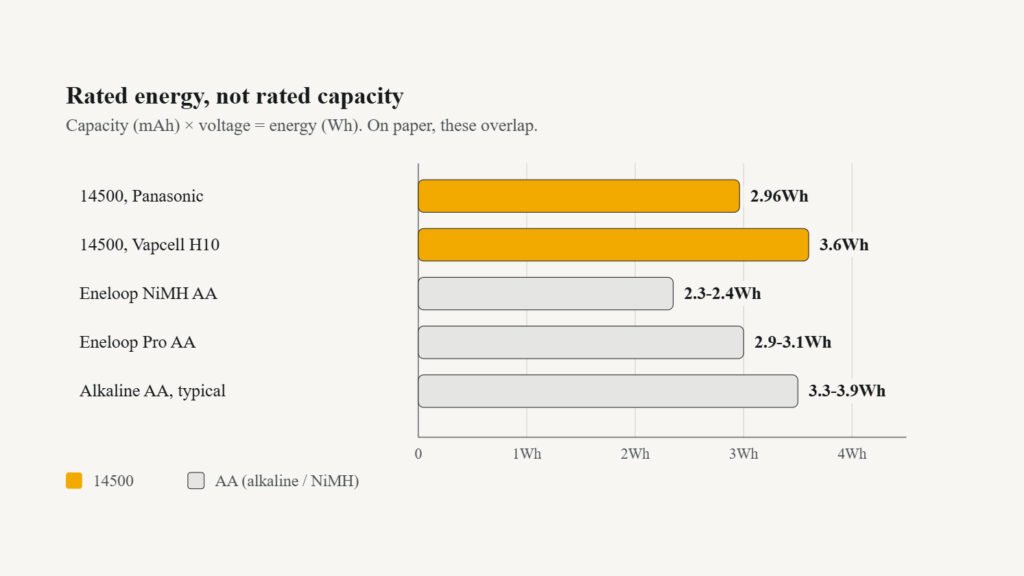
On paper, these land in the same ballpark. But this table compares labels, not results. Makers measure capacity under different conditions, and what a cell really delivers depends on how much current the light pulls.
Independent testers report that alkaline cells sag under heavy loads. Independent reviewers such as HKJ, the tester behind lygte-info.dk and a name flashlight forums often cite, publish graphs of how voltage falls as a cell empties.
It is found that cells deliver less than their labels claim. We did not pull numbers from his graphs, so treat the table as a starting point.
Real 14500 capacities also vary widely between makers, and no single figure describes “a 14500.” That is likely why articles on this topic quote different numbers. Each samples a different slice of a wide range.
Higher voltage tends to buy brightness, not endurance. In a light built for both cells, the extra voltage typically lets the driver push more current through the LED at the brightest settings. More current means more light, and it also drains the same energy faster.
Two forum reports fit this pattern, and both are single reports. In a 2016 thread, a poster summarizing a video review said a budget light ran about 20 minutes on a 14500 on “high,” against an hour on an AA.
We don’t know the model or the cells, and experienced members explained it this way. On a Zebralight, one owner said the brightness levels match between the two cells except for a brighter top setting on the 14500. Another guessed that low-setting runtimes would probably be comparable.
The practical reading:
- Short bursts of bright light: a 14500 in a compatible light is a reasonable choice.
- Long, low-output use: an AA or NiMH will probably last about as long, with less fuss.
A 14500 is not a free upgrade, and it is not a runtime upgrade.
It is a trade.
If you already own an AA light and are choosing between buying a lithium-capable one or staying with AAs, that trade is the deciding question. AAs are sold almost everywhere. 14500s usually need to be ordered.
How to find out whether your light takes a 14500
Take a light named “AA” that takes only 14500. The Lumintop FWAA is one. A buyer on Reddit put in an AA, got no light, and read the manual, which said 14500. A CandlePowerForums commenter said the light was designed for 14500 from the start, and called naming it “FWAA” “pretty dumb.”
The buyer’s assumption was reasonable. It was wrong anyway.
So the name is not evidence. Neither is the compartment size, nor the fact that a cell fits. The evidence is the manufacturer’s own documentation naming what the device takes. A useful line looks like “battery: one 14500 lithium-ion cell” or “input voltage: 3.0–4.2 V.” A line like “uses AA” is not permission to try lithium. Here is a routine that works:
- Don’t assume AA compatibility means 14500 compatibility. A 14500 has the same approximate dimensions as an AA but a much higher voltage. Unless the manufacturer explicitly confirms 14500 support, use a battery type the light is specified to accept.
- Find the manufacturer’s manual or product page. Prefer it to a reseller’s description, which can be wrong.
- Look for a stated cell type or voltage range.
- Treat silence as no. If the documentation doesn’t say, don’t guess.
A word on the phrase “AA/14500 compatible.” It tells you what the manufacturer claims the light supports. It is not, by itself, a certification or proof of independent testing. Check the manufacturer’s specifications for the supported battery types rather than relying on the product name alone.
Some flashlight enthusiasts describe circuit designs in which certain dual-voltage lights effectively bypass normal regulation when powered by a 14500.
We found no teardown of any specific model to confirm how a given light works. That is one more reason the documentation matters more than a guess.
If you have already put a 14500 into a device that wasn’t built for it, stop using it and take the cell out. Watch for heat, a burning smell, or a light that behaves oddly, and don’t leave a lithium cell in a device that seems wrong.
We can’t tell you whether damage has occurred. The manufacturer can, and a light that still works may not be a light that is fine.
If you go ahead: the cell and the charger
If the documentation says yes, three choices remain: the cell’s length, the charger, and the cell itself.
Cell length. Some 14500 batteries are longer than a standard AA because they have an added protection circuit and a raised button top. That extra length can prevent the battery from fitting in a flashlight designed around shorter cells. Forum members have measured individual 14500s at around 52–55 mm, compared with roughly 49–50 mm for shorter versions.
If a cell is too long, forcing the tailcap closed can put excessive pressure on the battery or the light’s internal components. Check the maximum battery length specified for your flashlight before buying a cell.
The charger. A charger built for NiMH or AA cells cannot safely charge lithium. Chargers are matched to chemistry, not to size.
Look for one that lists lithium-ion 3.7 V/4.2 V cells. Multi-chemistry chargers exist that detect the cell type. As a rough estimate, charging takes one to a few hours, depending on the cell and charger.
The cell itself. Buy from reputable sellers, not by advertised capacity. A 2025 X-ray inspection study, as reported by a technology news outlet, found one specific internal defect in nearly 8% of cheap or counterfeit lithium cells and in none of 300 cells from three major manufacturers.
It covered lithium cells in general, not 14500s specifically. Forum discharge tests of cheap 14500s have found capacities ranging from about three-quarters of the label down to a small fraction of it. A big number on a cheap cell is not evidence.
If you’d rather avoid all this
For most AA devices, a NiMH cell is the simple answer. It’s rechargeable, and its 1.2 volts suits most devices that take alkaline, though a few voltage-sensitive ones prefer 1.5 volts.
A third option exists (kind of): rechargeable lithium cells in AA shape with a built-in circuit that steps the output down to 1.5 volts.
Tenavolts and Keeppower are two makers. A CHOICE review, from the Australian consumer group, describes the step-down circuit in one of these cells, and such cells aren’t designed for high-current devices like flashlights. So this option fits remotes and clocks, not the light in your drawer.
What this can’t tell you
No article can say whether your specific device will survive a 14500. The circuit inside is out of sight, and it decides the outcome.
The energy comparison above uses rated figures, not delivered ones. The runtime observations come from forum reports, not controlled tests.
FactnFoton did not run any tests of its own for this article. It compared manufacturer datasheets, engineering documents, other people’s testing, and community reports, and noted where they agree.
The one rule
Put a 14500 in a device only if the device’s own documentation says it takes one. If you can’t find that, the answer is no.
The size tells you the cell will fit, but not whether it will work. The name doesn’t tell you either. The manual is where to look.
Search for your light’s model name plus “manual” on the maker’s own site.